
Zeus
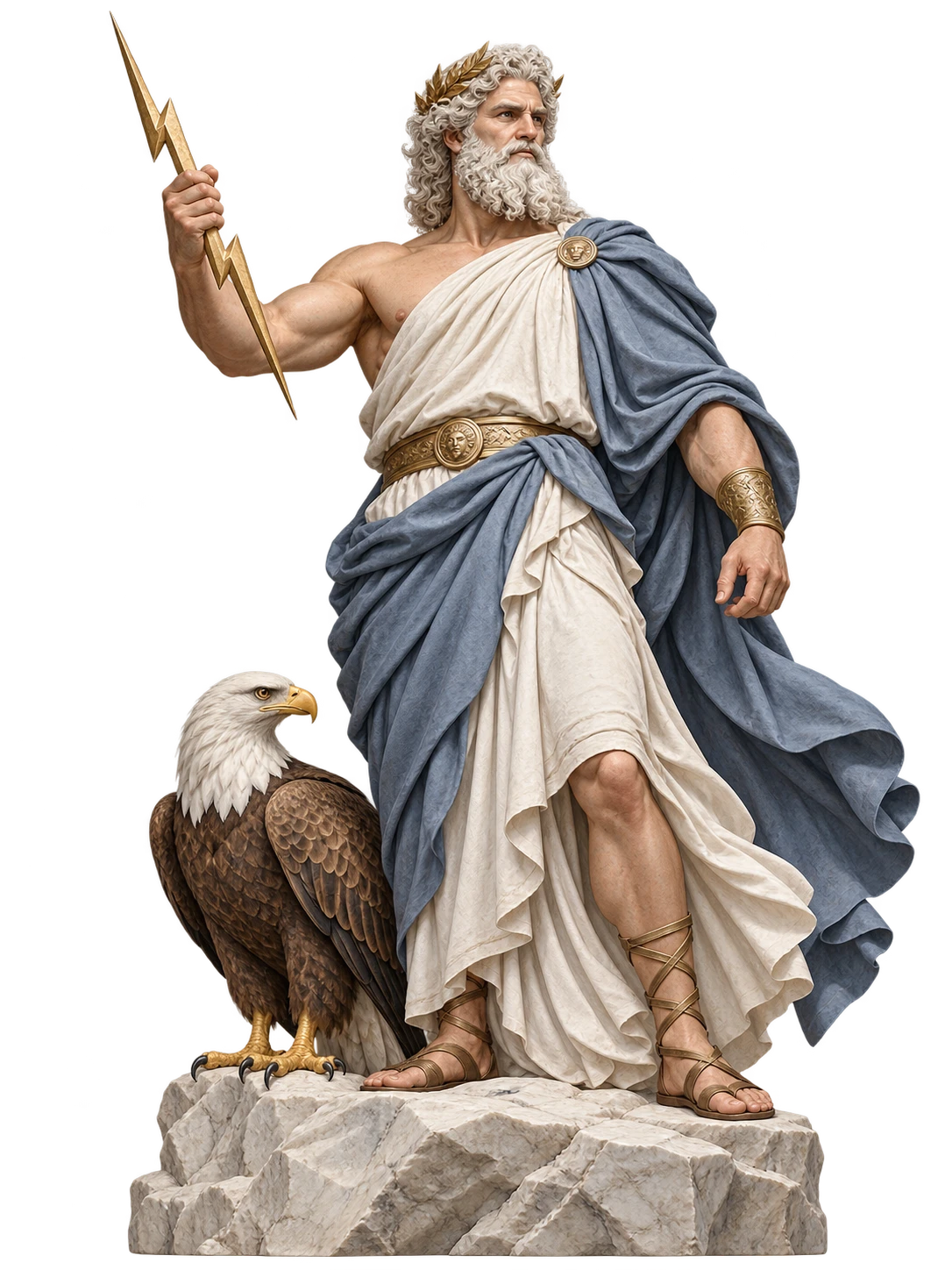
King of the Olympians and keeper of the sky, Zeus stands at the center of Greek divine order—wielder of the thunderbolt, guardian of law, and arbiter of fate.
The child hidden from a devouring king
Cronus swallowed each child born to Rhea, fearing the prophecy that one would overthrow him. When Zeus was born, Rhea concealed him in Crete and gave Cronus a stone wrapped in cloth. Raised in secrecy, Zeus returned to free his siblings and lead the younger gods in the Titanomachy. Victory established a new order: Zeus received the heavens, Poseidon the sea, and Hades the underworld.
Events that defined the ruler of Olympus
War for the cosmos
Zeus freed his swallowed siblings, allied with the Cyclopes and Hundred-Handers, and defeated the Titans after a ten-year war.
Olympus under siege
The monstrous Typhon challenged the Olympian order. Zeus met him with thunderbolts and secured his reign over gods and mortals.
Fire and punishment
When Prometheus stole fire for humankind, Zeus answered with a punishment that became mythology’s great conflict between authority and defiance.
The white bull
Taking the form of a gentle bull, Zeus carried Europa across the sea to Crete; her story became bound to royal ancestry and the name of a continent.
The scales of fate
Zeus watched over the conflict at Troy, weighing destinies while restraining and permitting the interventions of rival Olympian gods.
A dynasty of gods and heroes
More than a weather god
Zeus governs rain, thunder and the open sky, but ancient worship also treated him as a guardian of oaths, hospitality, justice, political order and the household. Epithets distinguished these functions: Zeus Xenios protected guest-friendship; Zeus Horkios oversaw oaths; Zeus Polieus guarded the city; and Zeus Herkeios protected the household enclosure.
His principal Panhellenic sanctuary at Olympia hosted the Olympic Games. Dodona, one of the oldest Greek oracular sanctuaries, interpreted the sound of the sacred oak and other signs. Local cults differed across the Greek world, so a responsible account separates widely shared Olympian mythology from regional ritual practice.
Sources, variants and interpretation
Hesiod's Theogony is fundamental for the succession from Uranus to Cronus and Zeus, the Titanomachy and the establishment of Olympian rule. Homer's Iliad presents Zeus as a sovereign who weighs competing destinies during the Trojan War, while the Odyssey emphasizes justice, hospitality and divine responsibility.
Stories of Zeus's transformations, relationships and descendants accumulated across centuries of poetry, drama, local cult and later Roman literature. They should not be read as a single biography written at one moment. This page therefore treats contradictions as evidence of a living mythological tradition, not as errors to conceal.